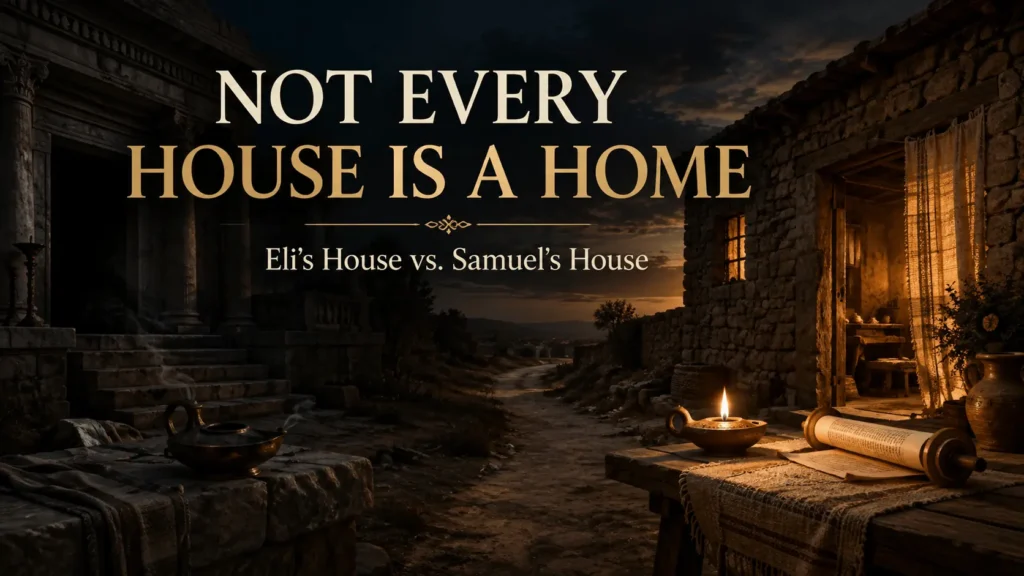
Not Every House Is a Home
Eli’s House vs. Samuel’s House
Based on 1 Samuel 2:12–17, 22–25; 3:11–14; 7:3–13; 8:1–8
Think about the difference between a house and a home. A house has walls, a roof, and an address. A home is different. A home is where love is real, truth is spoken, sin is not ignored, and God is actually welcome — not just mentioned. You can walk into a beautiful house and feel empty. You can walk into a small, broken-down house and feel welcomed. The difference is not the building. It’s what’s happening inside it.
So here’s the question: if God walked through the rooms of your life, would He find a house that talks about Him, or a home that truly honors Him?
This message is about two families in the Bible, and the same question sits over both of their front doors: house, or home?
To understand their story, we need a little background. Israel had been declining spiritually for about 450 years, all through a long, dark season called the era of the judges (Acts 13:20). The pattern kept repeating: God’s people would drift from Him, suffer the consequences, cry out for help, get rescued — and then drift again. One verse sums up the whole era:
“Everyone did what was right in his own eyes.”
Judges 21:25
Picture one of those spiral wishing wells you see at the mall, where you drop a coin in at the top and it circles faster and faster, tighter and tighter, until it finally drops into the hole in the middle. That’s what was happening to an entire nation. Each generation drifted a little further from God than the one before it, and nobody stopped the coin.
Eli and his generation were near the very bottom of that spiral. Eli was the priest in charge of Israel’s tabernacle — the tent that served as God’s house before the Temple was ever built. It was supposed to be a place where people met with God. Instead, under Eli’s leadership, even God’s own house stopped feeling like home. Eli’s sons, Hophni and Phinehas, were priests too, but the Bible calls them “worthless men” who “did not know the Lord” (1 Samuel 2:12). They stole meat from the sacrifices, abused their position, and treated God’s house like it belonged to them. Eli knew. He even confronted them with words. But he never removed them, and God held him responsible for that (1 Samuel 3:13). That’s how far down the spiral had gone: the sin was out in the open, the leader knew about it, and nothing changed.
Then Samuel shows up, and God begins to turn the story around. Raised up right in the middle of Eli’s collapse, Samuel calls Israel back to the Lord. At a place called Mizpah, he tells the people, “If you are returning to the Lord with all your heart, then put away the foreign gods” (1 Samuel 7:3). They listen. They confess, they worship, and God hands them a real victory over the Philistines — the enemy that had been beating them for years. For a while, the nation isn’t spiraling downward anymore. It’s coming back to life.
But Samuel gets old. He can’t do everything himself anymore, so he puts his own sons, Joel and Abiah, in charge as judges. And this is where the story gets uncomfortable: the elders of Israel actually notice their corruption and speak up about it. That’s real progress compared to Eli’s day — this generation can recognize a problem instead of just living with it.
Here’s the part that should stop you.
Those same elders — sharp enough to see the corruption in Samuel’s sons — could not see the drift in their own hearts. Instead of asking God what to do next, they told Samuel exactly what they wanted: “Appoint for us a king to judge us like all the nations” (1 Samuel 8:5). They weren’t really asking. They’d already decided. They wanted something they could see and control instead of trusting a God they couldn’t. God told Samuel plainly what was really going on:
“They have not rejected you, but they have rejected me from being king over them.”
1 Samuel 8:7
A generation that had just experienced real spiritual renewal quietly voted to reject God as their King.
So this isn’t only a story about Eli and Samuel. It’s a mirror. Eli’s house shows what happens when sin gets tolerated until it feels normal. Samuel’s house shows that even real revival doesn’t automatically protect the next generation. The question isn’t just “what was wrong with their house?” The question is, what’s happening in yours? What have you gotten used to that God is calling you to confront? And when things get hard, are you actually asking God what to do — or have you already decided, and you’re just waiting for Him to sign off?
That’s not just an ancient story. The same pattern is showing up again in our own generation.
America has had its own seasons of real spiritual awakening — massive movements under preachers like George Whitefield and D. L. Moody that shaped how people thought about God, morality, and freedom for generations. But revival in the past doesn’t guarantee faithfulness in the present. Israel had seen God move, and they still asked for a king “like all the nations.” In the same way, people today can look at the confusion around them and start trusting systems that leave God out — whether that’s socialism, communism, atheism, or any other human system that swaps God’s rule for man’s wisdom — more than they trust the Word of God.
That’s exactly the warning God gave Israel from the beginning: don’t become like the nations around you (Judges 2:2). The danger was never only political. It was spiritual. And it’s a warning that carries all the way into the New Testament, where Jesus said false leaders and false teachers would keep rising up until He returns (Mark 13:22), and John wrote that “even now are there many antichrists” (1 John 2:18). In other words: until Christ comes back, there will always be voices and systems trying to replace God’s truth with man’s wisdom.
That’s why this story still matters. The coin is still circling the spiral. The world still teaches people to do what’s right in their own eyes. But Scripture says a day of reckoning is coming, and every person will answer to God’s rule, not their own. Here’s the good news, though: just like God raised up Samuel before Israel hit bottom, God has sent someone greater than Samuel — Jesus Christ. He’s not just another warning voice. He’s the Savior and rightful King. Those who trust Him are rescued by grace. Those who reject Him remain under judgment. Jesus Himself put it plainly: “Fear him which is able to destroy both soul and body in hell” (Matthew 10:28). Pretending that word is uncomfortable doesn’t make it any less true.
| QUICK GUIDE: WHO’S WHO IN THIS STORY | |
| Eli | The aging priest responsible for Israel’s worship. |
| Hophni & Phinehas | Eli’s sons — corrupt priests. |
| Samuel | The child God raised up to become Israel’s prophet and judge. |
| Joel & Abiah | Samuel’s sons, who later became corrupt judges. |
| The Elders | Israel’s leaders, who came to Samuel and asked for a king. |
We’ll walk through this story in four movements: first, Eli’s house and the collapse of leadership; second, Samuel’s house and the revival God brought through him; third, the sons in both families and what their corruption revealed; and fourth, the elders’ request for a king and what it exposed about Israel’s heart.
Eli’s House: A Priesthood in Collapse
By the time we meet Eli, Israel’s spiral downward was almost at the bottom. Eli was the priest in charge of the tabernacle, the place where Israel worshiped God before the Temple was built. His sons, Hophni and Phinehas, used that position to sin instead of serve. They stole meat that belonged to God from the sacrifices, and they treated holy things like something they were owed instead of something sacred (1 Samuel 2:12–17, 22). Eli knew about it. He even confronted them with words (1 Samuel 2:23–25). But he never removed them from their positions, and God held him responsible for that (1 Samuel 3:13). That is the real collapse in this story — not just two corrupt sons, but a leader who saw the sin clearly and still wouldn’t act.
Samuel’s House: A Revival of Leadership
Samuel is the opposite story. God raised him up in the middle of Eli’s failure, and he became exactly the kind of leader Eli wasn’t. At Mizpah, he called Israel to get rid of the false gods they’d been worshiping and to return to the Lord (1 Samuel 7:3). The people listened. They confessed, they worshiped, and God gave them a real victory over the Philistines, an enemy that had been beating them for years (1 Samuel 7:5–13). Under Samuel, Israel’s conscience woke back up. He did what Eli should have done: he led people back to God instead of just talking about God.
The Sons of Eli: Corruption Without Accountability
Hophni and Phinehas didn’t just sin quietly. They stole from the sacrifices, mistreated the people who came to worship, and disrespected the tabernacle itself (1 Samuel 2:12–17, 22). And nobody stopped them. Eli warned them, but warning wasn’t enough — he never removed them from their positions, and God judged him for it (1 Samuel 3:13). Their corruption wasn’t a private problem. It was public, and it was allowed to continue.
The Sons of Samuel: Corruption With Confrontation
Samuel’s sons, Joel and Abiah, were corrupt too — just in a different way. Instead of stealing sacrifices, they took bribes and twisted justice as judges in Beersheba (1 Samuel 8:1–3). But this time something different happened: the elders of Israel actually noticed, and they said something. That’s real progress. Samuel’s leadership had woken people up enough to recognize when something was wrong instead of just living with it.
The Elders Under Eli: Spiritually Blind and Compromised
So why didn’t anyone speak up while Eli’s sons were sinning? Because the elders around Eli weren’t any better off spiritually. Whether it was fear, or because they benefited from the corruption themselves, or because they had simply gone numb to it — they let it continue. Their silence didn’t just fail Eli’s sons. It kept the whole nation sliding further into the pattern the book of Judges describes: everyone doing what felt right to them instead of what God said.
The Elders Under Samuel: Spiritually Awake Yet Self-Deceived
The elders under Samuel were different — at least at first. They could see that Samuel’s sons were corrupt, and they weren’t willing to stay quiet about it the way the elders under Eli had been. That’s real spiritual growth. But here’s the catch: they could see the problem in Samuel’s sons, and they still couldn’t see the problem in themselves. Instead of asking Samuel to seek God’s direction for what came next, they told him exactly what they wanted: “Appoint for us a king to judge us like all the nations” (1 Samuel 8:5). They weren’t really asking. They’d already decided.
The Fatal Request: A King Like the Nations
Here’s what makes their request so serious. If they had asked for “the king God chooses,” this would be a different story. Instead, they asked for a king “like the nations” — meaning they wanted what everyone else around them had: someone visible, someone with an army, someone they could see and point to. They wanted something they could control instead of a God they had to trust. God told Samuel exactly what was happening:
“They have not rejected you, but they have rejected me from being king over them.”
1 Samuel 8:7
A generation that had experienced real revival under Samuel still chose sight over faith.
So What Does This Mean for You?
Eli’s house shows what happens when leaders see sin and still don’t act. Samuel’s house shows that real revival is possible — but it also shows that revival in one generation doesn’t guarantee faithfulness in the next. Eli’s sons sinned, and nobody stopped them. Samuel’s sons sinned, and people finally spoke up — real progress. But the elders who spoke up so clearly about someone else’s sin still couldn’t see their own drift. They could point out the problem in the next generation and completely miss the problem in their own hearts.
That’s the warning for every generation, including ours. It’s possible to talk about God, sit in church, and even experience real spiritual growth — and still slowly drift toward trusting something you can see and control more than you trust the God you can’t.
So here’s the real question this story is asking you: is there anything in your life right now that God is calling you to confront, let go of, or rebuild?
Not someone else’s house. Yours.
Heavenly Father, thank You for Your Word today. Remind us that You are not inherited. Samuel’s revival did not automatically become his sons’ faith, and it will not automatically become ours just because someone before us knew You.
So we choose You now — not on our parents’ faith, not on a revival from the past, but as our own King today. Forgive us for coasting on what previous generations built, instead of seeking You ourselves.
Make our house a home again, in this generation. Not because it was passed down to us, but because we have chosen to give You the throne.
In Jesus’ name, amen.